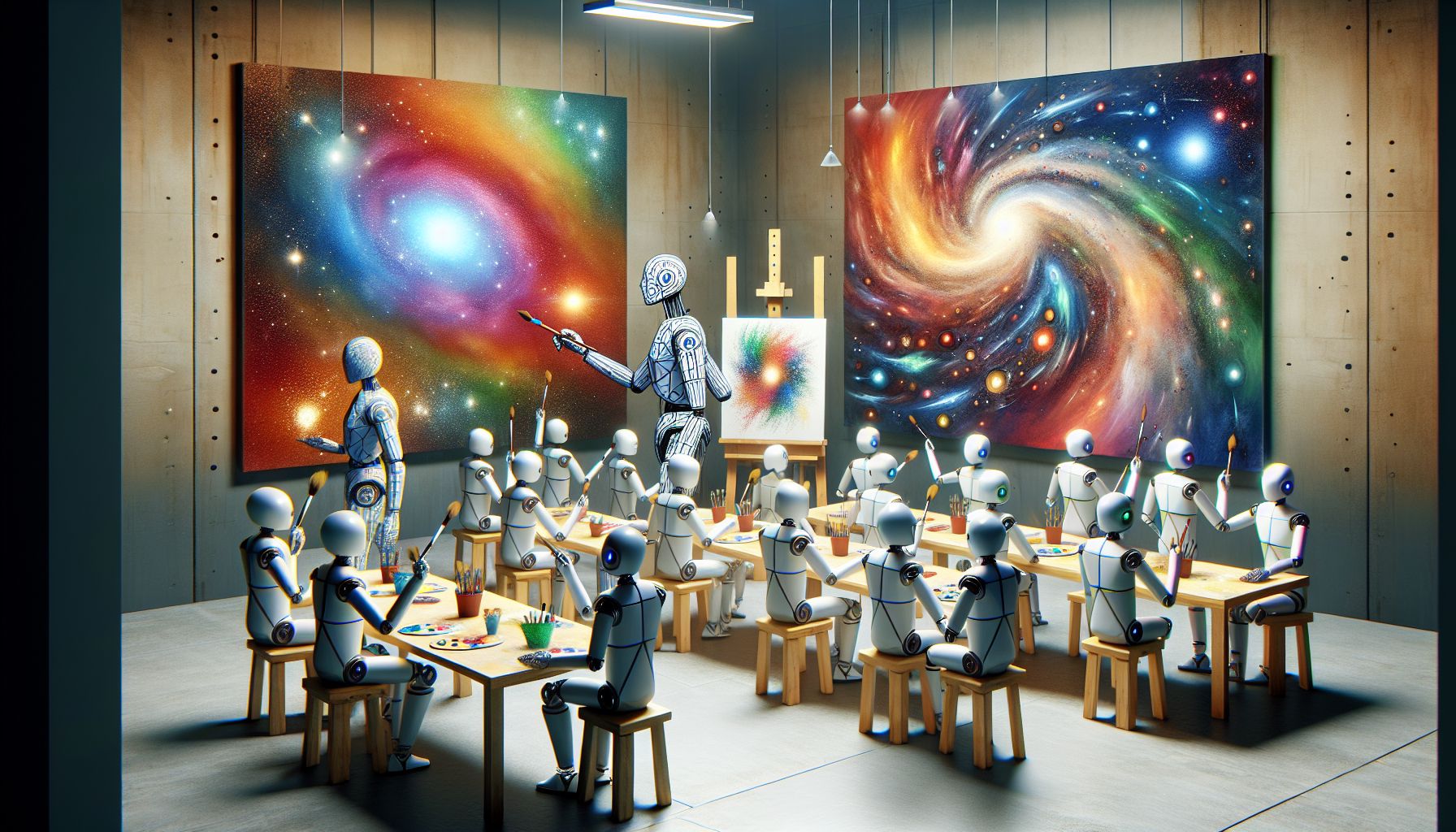
You know that feeling when you’re browsing through an art gallery, marveling at the works of Picasso or Van Gogh, and suddenly, something hyperrealistic that’s not quite human-made grabs your attention? Well, folks, we’re living in a time where that something might just literally be out of this world—or more accurately, out of some insanely convoluted neural network. Today, I want to talk about the hyper-evolution of AI in the creative arts. It’s not just a novelty act anymore; it’s an art movement in its own right.
Oh, and buckle up! This one’s for the lovers of high-tech dreams and jaw-dropping creativity. Spoiler alert: it involves robots that can paint, and they’re getting scary good at it.
The Painting Circuit: Where It All Began
When we talk about AI turning into Picasso 2.0, it’s easy to forget how we got here. I still remember the days when rudimentary art machines were “finding themselves”. It was the era of DALL-E and its ilk, fascinating and yet occasionally producing images that looked like melted marshmallows. These early programs were the toddlers of the AI art world, stretching the limits of what we thought a machine could visualize—or get hilariously wrong.
Back then, the process felt almost alchemical. You’d feed quirky inputs into a black box and get a mix of brilliance and absurdity. I once gave it a prompt for an “otter playing chess with Einstein”—you wouldn’t believe the results. Oh, and yes, I printed it and hung it in my office.
Rise of the Art Bots
Fast forward a few years, and boy, have the art bots grown up! Companies are now developing algorithms that train themselves on massive datasets of art from all genres and times. These aren’t your slightly awkward digital painters anymore. These algorithms can mimic styles with such precision and finesse that they’re being featured in galleries.
Take Google’s DeepDream, for instance, which made waves with its hallucinogenic art, or OpenAI’s DALL-E that came back with considerably fewer marshmallows. Add to that the generative adversarial networks (GANs), and we’re talking about art that’s not just good, it’s mind-boggling.
Seriously, some pieces can evoke emotion in a way that’s utterly human. It’s like stepping into a world where robots not only can but want to scribble alongside us.
Implications for the Arts and Society
Alright, so what does this mean for the future of art, and for us mere mortals? For starters, more art for everyone! On a consumer level, this means people can personalize their spaces with high-quality, custom artwork. It’s like the IKEA of art, but you don’t have to build it yourself or pretend to understand minimalist Swedish design.
But it goes deeper than that. The democratization of art-making could dramatically impact the creative economy. Art has historically been gatekept by galleries and high-profile collectors. Now? You might have a chance to snag a masterpiece from the comfort of your living room (or maybe your jet-setting vacation home if you’re fancy like that).
And here’s a kicker: it’s all changing the way we define creativity. Human-made art has always been about soul and perspective. Can AI-generated art have the same depth? That’s a debate raging across artistic circles. While some see this as fertile new territory for collaboration, others view it as a form of cultural dilution.
Challenges and Critiques: Art Utopia or Dystopia?
Not everyone is on board the AI art train, and that’s okay. We love a good debate. There are valid concerns swirling around the ethics and implications of AI-generated art.
Firstly, let’s talk about copyright. If an AI scans thousands of images to learn how to paint, who owns the result? The artist whose work was used? The developer who wrote the algorithm? Or maybe that cheeky AI fellow itself? Tricky, right?
Then there are big questions about the value of human creativity. As machines become more adept at it, might we lose appreciation for the “by hand” effort? Some argue it’s an existential threat to our artisanal sectors, including something as tactile and personal as we imagine art to be.
Looking Forward: A Creative Singularity?
So, where does this techno-utopian odyssey lead us in a decade or so? If there’s one thing sci-fi has repeatedly told us (in between the alien invasions and dystopian futures), it’s that anything is possible, and I, for one, can’t wait to see where this trajectory takes us.
Might we see collaborations between human and machine celebrated as the new standard? Maybe artists will supersede the role of being creators and become curators of cosmic visual experiences, selecting from a library of possibilities crafted by these digital entities?
Ultimately, art is constantly changing, and this could inspire us to redefine creativity altogether. The techno-biological synthesis could be the dawn of something completely new in art. Imagine a world where half the works in the Louvre could be made by digital minds, sparking joy and reflection in entirely new ways.
To wrap it up, brace yourselves. The weird, wonderful world of AI in creative arts is just getting started. So crank up your imagination and stay tuned. The androids with paintbrushes aren’t going anywhere, and who knows, maybe the next masterpiece will be born at the intersection of silicon and stencil. Happy musings, folks!